
Life is Strange
Why is the Natural World So Weird?


It’s been almost 100 years since the scientist J.B.S. Haldane proclaimed that “the Universe is not only queerer than we suppose, but queerer than we can suppose.” In other words, he believed that as we continued to understand the true nature of existence, it would surpass anything we could dare to imagine. Well, now with the hindsight of an additional century of scientific discovery, we can safely say he was correct. Life has turned out to be so much more absurd than anyone could have predicted.
As a molecular biologist, I’ve read countless stories about the weirdness of living things and the natural world. Life is truly absurd. It’s surprising. It’s obscure. But why is life so strange?
For a long time, I didn’t know what to make of it. But now I have the answer I was looking for. Here is my exploration of the truly bizarre world that we emerged from, that we are part of, and how I’ve come to terms with the absurdity of life.
Humans are part of the Natural world
When Charles Darwin’s theory of evolution was presented to the world in 1859, there was outrage at the idea that humans are on the Ape branch of the tree of life. One of Darwin’s supporters T. H. Huxley, and the brilliantly named Samuel Wilberforce, the Bishop of Oxford, were on opposite sides of what became known as The Great Oxford Debate in 1860.
Wilberforce asked Huxley, “Was it through his grandfather or his grandmother that he claimed his descent from a monkey?” And equally entertaining was Huxley’s response that he would prefer an ape as an ancestor over a man like Wilberforce, one “endowed by nature and possessed of great means and influence…who employs these faculties for the mere purpose of introducing ridicule into a grave scientific discussion.”
Of course, no one’s grandfather or grandmother is a monkey, unless you are a monkey. But the truth is almost as absurd. If you had a photograph of every one of your ancestors going back in time, you would eventually reach a life form that more closely resembles our modern-day apes, such as chimpanzees and bonobos, than a human. But that would require photographs going back a few million years. You see, Wilberforce was overlooking what is possible given enough time and gradual change. That’s partly why it took so long for an acceptable theory of evolutionary change to be put together: we were only just beginning, in Victorian Britain, to appreciate the vastness of deep geological timescales. It was becoming clear that the Earth is many millions of years old rather than thousands, and it wasn’t until the 1950s that we got our first really accurate dating, which put the Earth at 4.54 billion years old (if we show the zeros, that number looks like this: 4,540,000,000 years old).
The Truth is even more Peculiar
If we were to continue going back in time, visiting more of our ancestors, we would see that tens of millions of years ago, during the time of the dinosaurs, our ancestors were likely nocturnal, shrew-like animals. Further back still, we’d meet the fish-like amphibian that was developing adaptations that would allow it to move out of the water and onto land. (That’s the ancestor of all amphibians, reptiles, and mammals). Go back even further, and we meet the single-celled eukaryotes. All the complex organisms you see today are eukaryotic; that is, they are made up of a particular type of cell. We are multicellular conglomerations of eukaryotic cells, many trillions of them, but some eukaryotic organisms still exist or can exist as single cells. But we can go back even further: before the eukaryotic cell, there were prokaryotes. Prokaryotes include bacteria and the final domain of life, the archaea. (This gives us the 3 domains of life: bacteria, archaea, and eukarya). Prokaryotes have simpler, smaller cells than eukaryotes. Take a look at Figure 1, where I have tried to put all of these biological events into the context of the history of the Universe.
In fact, the eukaryotic cell that makes us up contains mitochondria, which are the powerhouse of the cell, as you may know from school. They were once a free-living bacterium which is thought to have found itself in a symbiotic relationship living inside an archaeal cell of some type. So there you have it, you are not just an ape, you are the descendant of a cell type which was created by the fusion of two different forms of microbial life. And we could do a whole article about the wonders of mitochondria; they carry out aerobic respiration, in other words, they are a large part of the reason that we use oxygen, they use it to produce huge amounts of ATP, the energy currency of the cell. This was all found out relatively recently, thanks to the work and advocacy of Lynn Margulis in the 1960s, and it was confirmed by molecular analysis in the 1970s.
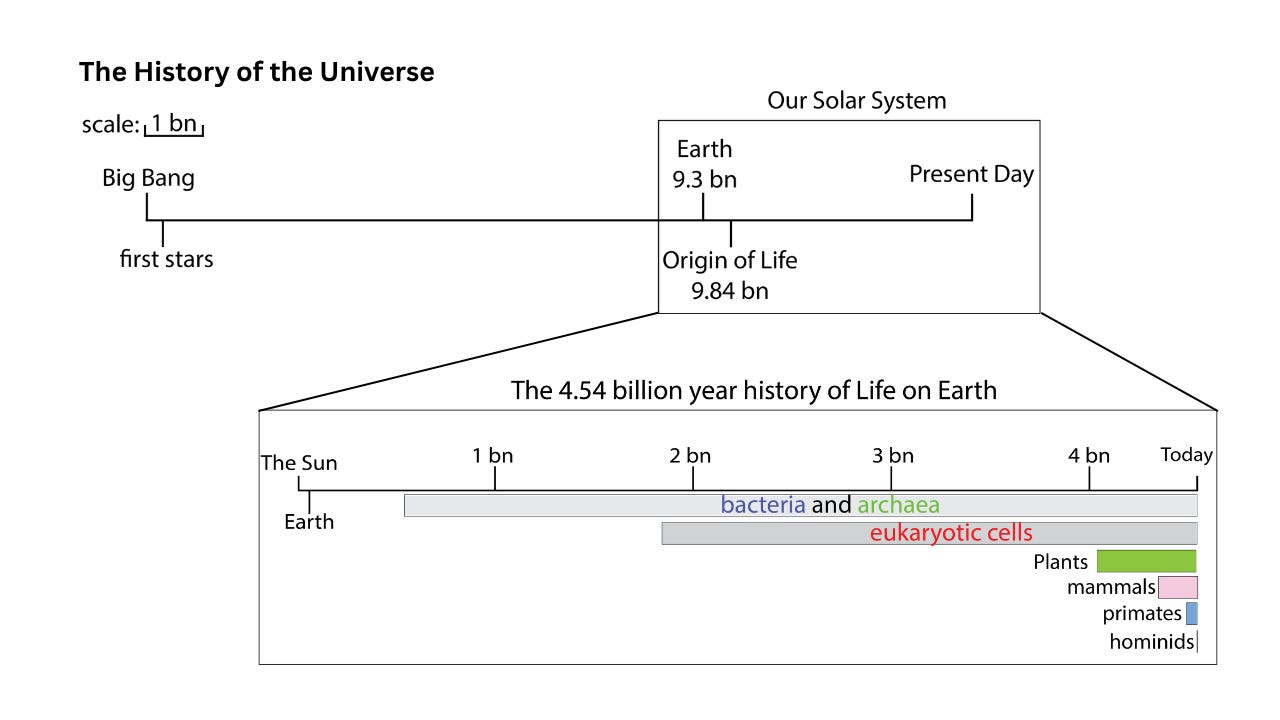
We know that all life is inter-related because it all uses the same (or extremely similar) genetic machinery: the same inherited information, DNA, which is transcribed to RNA before being translated to produce proteins, which are the molecules which do most of the work in the cell, including building cellular structures and membranes. So whether you are a bacterium, an archaeon, or a eukaryote, you have inherited this system for being alive. This is why a Professor of microbiology, who was one of my undergraduate lecturers, described us, and all complex life, as elaborate microbes.
But it gets even weirder. It is estimated that as much as 8% of the human genome is made up of endogenous retroviral elements. These are a type of virus that managed to get into the germline of our lineage over the years. The most famous (or infamous) example of a retrovirus is HIV, and these viruses integrate a DNA copy of their genome into our own DNA. Weirder still, Syncytin-1 is a protein that plays an important role in cell fusion during human placental development. The gene encoding this protein is part of one of these endogenous retroviral elements; in other words, it is derived from an ancient endogenous viral infection but has acquired a new biological role within us.
Science Explores the Gap between Perception and Reality
In order for science to make these advances and insights, it required new technologies or at least new ways of looking at the natural world. The fact that all life is cellular in nature first required the enhancement of our visual capacities. Single-celled organisms are too small to see with the naked eye, and it was thanks to developments in lens technologies and the development of higher-powered microscopes that we could appreciate their existence. The Dutch scientist Antonie van Leeuwenhoek was the pioneer here (as well as Robert Hooke in England). Leeuwenhoek observed what he called “animalcules” in pond water, which were single-celled organisms. It took a couple of centuries for us to start to appreciate that all life, including ourselves, is cellular in nature. This is at least as absurd as Darwin’s findings. But why is the natural world, and life, so weird?
Here we need to take a step back. Absurdity, peculiarity, obscurity, all of these words appropriately describe the surprisingly weird nature of life. The reason life appears absurd is that it is deeply unfamiliar to our everyday experience of being human. Evolution has endowed us with our sense of vision, taste, smell, touch, and hearing, which are then integrated by our central nervous system to create a model of reality which allows us to survive, find food, escape danger, and find mates. In The Case Against Reality: How Evolution hid the Truth from our Eyes, author Donald D. Hoffman argues that our perception of the world is not an accurate recapitulation of reality, and in some cases is wildly wrong.
This is why life feels absurd: science, by augmenting our sense of sight, reveals a world of microscopic cells we could not have anticipated. But it is not always technology-driven (it often is, though); it can be conceptual, too. Charles Darwin wasn’t the first evolutionist, but he gave the first widely accepted theory of how organisms change over time. And that’s the keyword here: time. The Scottish geologist Charles Lyell had shown that the timescales we are dealing with are so vast as to be beyond human comprehension, which meant that gradual change could result in massive changes over such timescales. (And it took the development of radiometric* dating for us to get the first accurate assessment of Earth’s age a hundred years later in the 1950s). To take another example, by 1953, developments in X-ray crystallography and electron microscopy gave biologists access to the world of atoms and molecules. Light microscopy, like the type used by Leeuwenhoek, has limited resolution due to the wavelength of light, but both electrons and X-rays have shorter wavelengths than light, which means even greater magnification and resolution. Now we could probe the subcellular environment and examine specific molecules, such as DNA and proteins. This was what ignited the Molecular Revolution in Biology and ultimately led us to fully decipher the genetic code (and how it relates to RNA and Protein), and later to the realisation that all living organisms on Earth use a similar system. Finally, it was only because of developments in sequencing technologies that allow us to read whole genomes that led to the appreciation of the great number of viral sequences in our genome, which I mentioned earlier.
Absurdism
In coming to terms with the weirdness of the natural world, I was drawn towards philosophy and the idea of the Absurd for answers. Absurdity has a specific meaning in existential philosophy. It was a term that had been around for a long time but underwent a resurgence with the work of writer Albert Camus and his 1942 book The Myth of Sisyphus. In short, The Absurd (as Camus specifically called it) is the conflict between humans, as conscious entities, and the rationalistic understanding of reality that has emerged from our modern scientific knowledge. Camus was thinking about the meaning or lack of meaning in human existence. I’m not discussing that so much here, but I have discussed it previously (see my article The Illusion of Meaning). Here, I am invoking absurdity in a way similar to Buddhist philosophy, which describes how our conscious awareness can sometimes obscure the true nature of reality. In Buddhism, the word dukkha describes (approximately) the suffering or friction we feel when our expectations of reality are not congruent with its true nature; for example, the denial of our own mortality is a source of dukkha. We can add to this Hoffman’s perspective from The Case Against Reality: evolution doesn’t necessarily endow us with sensory and nervous systems that authentically capture the world. Through scientific and technological interventions, we can reveal whole new layers of reality that were previously inaccessible to our evolved senses.
In other words, that is why Camus’ sense of the absurdity of the human predicament was so urgently distressing, so dissonant; it’s because science narrows the gap between our perceptions and reality, and in doing so shatters our expectations and illusions. By Camus’ time in the 1940s, the scientific revolution, which began in the 1500s, had been churning long enough to dispel many of these illusions. The privileged place of humanity as separate from the natural world had long become untenable.
Quantum Mechanics: The Great Absurdity?
When I threw out my examples of our microbial ancestry and the viral sequences in our genome online, I asked if anyone had a better example of reality’s weirdness. And the same answer came back time and time again: quantum mechanics. This was a field just emerging when Haldane made his “queerer than we can suppose” prediction, and so no doubt influenced his appreciation of the bizarre.
I’ve spoken about how, as we have analysed life at the cellular level and then the sub-cellular level of molecules like DNA and proteins, we have found some pretty wild stuff. Well, if we drill down further to the level of atoms and sub-atomic particles, we find that reality is pretty much incomprehensible, at least to our human minds.
We’ll think of this in simplistic terms. Atoms are what make up everything we know and love: planets, stars, and living things. There are other forms of matter such as anti-matter and dark matter, which probably deserve a mention in an article all about the “weird”, but we’ll save that for another day. Anyway, the atoms we are familiar with have a nucleus containing protons and neutrons, surrounded by electrons. The number of protons and electrons in a particular type of atom conveys its properties and how it interacts with other types of atoms. This gives an atom its atomic number and is the basis for our periodic table of elements.
The reason it’s called quantum mechanics is that many physical quantities such as energy, angular momentum (including spin), and, in confined systems, momentum can take only discrete, quantised values. Subatomic particles exhibit strange properties such as wave-particle duality. To summarise a large body of experimental work and mathematical formulations, electrons display both wave-like and particle-like properties depending on how they are measured. Quantum mechanics describes an electron using a wavefunction, which spreads out through space and predicts the probability of finding the electron in different locations. When a measurement is made, the electron is observed at one specific location. In the traditional Copenhagen interpretation, this is described as the wavefunction collapsing.
There has been a lot of pseudoscience built up around that fact, the idea of consciousness interacting with quantum objects, meaning both consciousness and the quantum are fundamental features of reality.
Today, most physicists reject the idea that consciousness is required for measurement. Instead, interactions with the surrounding environment rapidly destroy observable quantum properties, a process known as decoherence. Decoherence explains why macroscopic (large) objects behave classically, although it does not, by itself, solve the deeper question of why measurements appear to produce a single, definite outcome. That is why, for the most part, we can think of living organisms in classical terms, in other words, behaving “normally”, because the crowded environment of the cell erases the weirdness through a constant bombardment of interactions at the atomic level. It should be noted, though, that there are quantum effects that are important in biological systems, such as in the functioning of enzyme catalytic sites and the process of photosynthesis, which involves the quantum tunnelling of electrons, allowing them to traverse energy barriers.
The other quantum effect I will mention is quantum entanglement, which Albert Einstein famously called “spooky action at a distance”. Consider two particles that have become entangled. Their quantum states are correlated: if one is measured to have spin “up”, the other will be measured to have spin “down”. (In this hypothetical example, conservation laws mean that if one particle is measured as spin up, the other must be measured as spin down.) Even if the particles are separated by billions of miles, measuring one instantly tells you what result would be obtained from measuring the other in the same way. The correlations appear immediately, regardless of distance; exactly how to interpret this remains one of the deepest questions in quantum physics.
Some theoretical physicists argue that our best chance at a unified theory of everything will come from Quantum Field Theory (QFT), which combines quantum mechanics with special relativity. Rather than thinking of protons, neutrons or electrons as particles, QFT views them as perturbations or undulations in an underlying field that permeates our reality.
In his book Physics Fixes All the Facts, Liam Graham argues that the world we perceive could not be more different from its true nature:
“Almost everything we think we know about the world is wrong. The sky isn’t blue. Nothing is blue. There are no colours. You are not holding a book. There are no books. Instead, there are quantum fields arranged blue-wise or book-wise. These interact with other quantum fields arranged person-wise and so reconfigure them into a state that corresponds to seeing a blue sky or holding a book.
If quantum physics is beyond our imaginative understanding, its implications for ourselves and the universe as a whole will necessarily make no sense to us.”
That perspective takes us to the most extreme possibility: that our perception is so grossly misaligned with reality that everything is illusory. But there are still many difficulties for QFT, including its failure to accommodate the force of gravity at present. Regardless of QFT’s future success, there is no doubt in my mind that the greatest absurdity we are aware of lies at the quantum level.
Final thoughts: Life is not Absurd… Quantum Mechanics might be
Life isn’t absurd or weird; life just is. Absurdity is not a property of the natural world; it is a description of the friction between my human consciousness and the true nature of reality. Our expectations of reality have evolved for purposes other than scientific research. As we have enhanced our capacity to investigate the world around us, it has revealed us to be very different things from how we might feel, as humans. That we are descended from microbes makes scientific sense: complex life has emerged from more humble beginnings. Greater complexity arose stepwise from lesser complexity. But it still feels ridiculous, or maybe wondrous; the reaction may depend on the person. Personally, I think it’s great.
That your own cells contain the descendants of once free-living bacterial cells in the form of mitochondria has always seemed to me a fantastically wild yet true fact of life. And there has been some very interesting theoretical work on the evolution of these types of symbiotic (mutually beneficial) relationships, which helps us understand how they came to be. But I will save those fascinating details for another day.
Likewise, given that there are viruses that can insert their genomes into our own, it makes sense that these would turn up when we sequence entire human genomes. If something confers new properties, such as the viral Syncytin-1 protein, it will be retained by natural selection. As for the 8% of the rest of the genome that has viral sequences, some of them may have biological functions; most will not, but if they aren’t actively deleterious before reproductive age, then again they will be kept, or more accurately, not selected against.
Finally, quantum mechanics. Given the counterintuitive nature of quantum phenomena, physicists have developed many interpretations of what the mathematics means, giving rise to different schools of thought. Some argue that the apparent weirdness results from our everyday concepts of waves, particles, and reality itself being inadequate for describing the quantum world. Others argue that quantum mechanics reveals something genuinely fundamental about nature: that, at its deepest level, reality does not conform to the classical (sensible) picture we might expect.
I’ll leave you with lyrics from one of my favourite songs, which captures the absurdity of life. It’s called In the Aeroplane Over the Sea by Neutral Milk Hotel.
“What a beautiful face I have found in this place that is circling all ‘round the sun. And when we meet on a cloud, I’ll be laughing out loud. I’ll be laughing with everyone I see. Can’t believe." How strange it is to be anything at all.”
References
Possible Worlds by J.B.S. Haldane is the source of the “queerer than we can suppose” quote. And this is the quote in full: “my own suspicion is that the universe is not only queerer than we suppose, but queerer than we can suppose. I have read and heard many attempts at a systematic account of it, from materialism and theosophy to the Christian system or that of Kant, and I have always felt that they were much too simple. I suspect that there are more things in heaven and earth than are dreamed of, or can be dreamed of, in any philosophy.”
I relied on Michael Taylor’s presentation of The Great Oxford Debate in his Big Think article titled: Huxley vs. Wilberforce: What really happened at the 1860 Oxford evolution debate- The true story of the shot that “reverberated through England” when science collided head-on with religion.
The Case Against Reality: How Evolution hid the Truth from our Eyes by author Donald D. Hoffman looks at a number of studies which prove the fallibility and inaccuracy of our senses. They are good enough for what we need; they have, of course, serious utility, but as an accurate rendering of reality, they fall short.
The Myth of Sisyphus by Albert Camus is the book where he presents his concept of The Absurd. But I would recommend philosopher Todd May’s modern reimagining of The Absurd in his book A Significant Life — Human Meaning in a Silent Universe.
Physics Fixes All the Facts by Liam Graham explores whether we can reduce all we know in biology, chemistry, cosmology, and related fields to the language, mathematics, and models of physics. It’s the strongest case for reductionism I have read. I don’t quite know where I stand on the reductionism debate just yet. I am a biologist. I am interested in understanding life. Graham would argue that the need for biological descriptions is a temporary placeholder for a deeper future physical understanding of the living system.
For more on quantum effects in biological systems, check out Life on the Edge: The Coming of Age of Quantum Biology by Jim Al-Khalili and Johnjoe McFadden.
Additional notes
*Thanks to Ursula Goodenough for pointing out that it should be radiometric dating rather than radiocarbon dating for the age of the Earth. Carbon does not have a long enough half-life for such vast timescales. Great spot, thank you.
I am a molecular microbiologist. In this article, I wrote about quantum mechanics for the first time. I have read Liam Graham’s Physics Fixes All the Facts, Carlo Rovelli’s Helgoland: The Strange and Beautiful Story of Quantum Physics, and Jim Al-Khalili and Johnjoe McFadden’s Life on the Edge, which were great resources. Quantum mechanics is a very difficult thing to think about, let alone write about (particularly if, like me, you are not a physicist); after all, Richard Feynman famously stated that “If you think you understand quantum mechanics, you don’t understand quantum mechanics”
So, to prevent misinformation (as far as possible), I first wrote the quantum mechanics section of this article and then asked ChatGPT (GPT-5.5-mini model) to fact-check it, which recommended several refinements and improvements for accuracy. In future, I think I’ll stick to what I know better, which is biology.
Again, very sell,done
Chris Earl's article illustrates a profound shift that has taken place in modern biology. Organisms are increasingly understood not as stable material entities, but as dynamically maintained organizations of processes. Biological identity arises not from the persistence of matter, but from the persistence of organization.
Classical intuition
matter ─────► organism ─────► function
Modern biology
organization ─────► continuous reconstruction ─────► function
│
└── material components may be replaced
Meta-Evolution accepts this perspective as its starting point but proposes a change in the level of analysis. Instead of asking how organisms evolve, it asks what actually evolves.
A broader discussion of evolutionary systems and the Meta-Evolution framework is available here:
https://substack.com/home/post/p-207119065